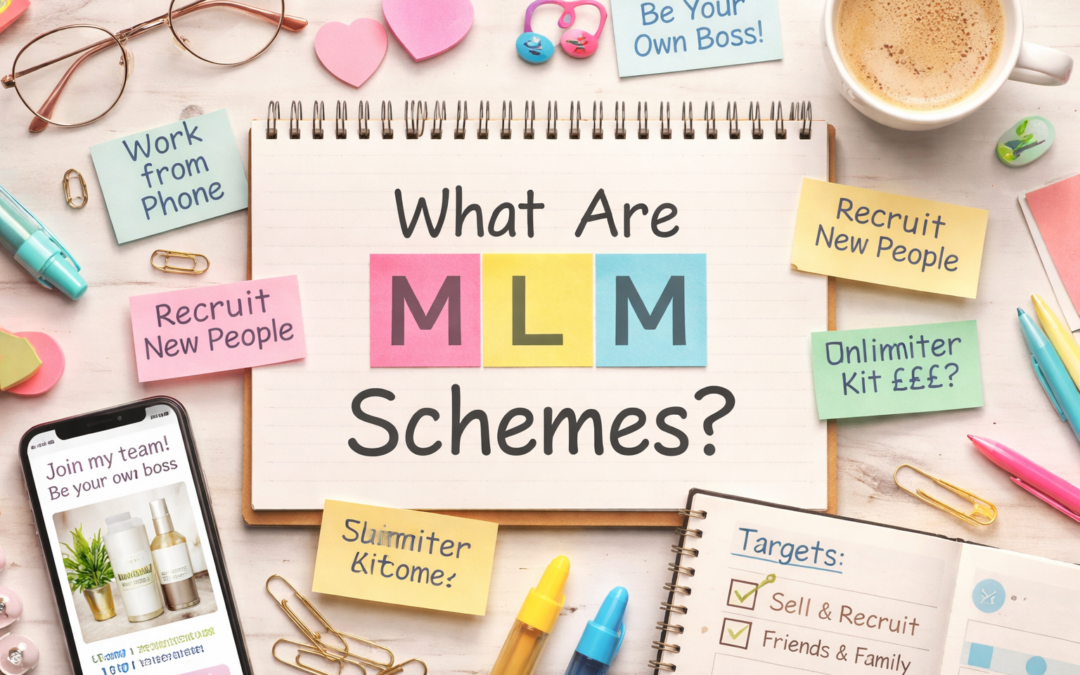
If you’ve ever had a random message saying, “You’d be amazing at this” or “Fancy earning extra income from your phone?” — chances are you’ve already come across an MLM.
MLM stands for multi-level marketing. Some people call it network marketing or direct selling, which sounds much nicer and a lot less suspicious. But if you’ve ever felt a bit uneasy about the whole thing, you’re not imagining it.
MLM schemes are often sold as a flexible way to make money, especially to women, mums, carers, and anyone feeling a bit stretched financially. They promise extra income, freedom, confidence, community, and the chance to “be your own boss”. On the surface, it can sound brilliant.
But once you scratch beneath the motivational quotes and Instagram posts, the reality is often a lot less empowering.
So, what is an MLM?
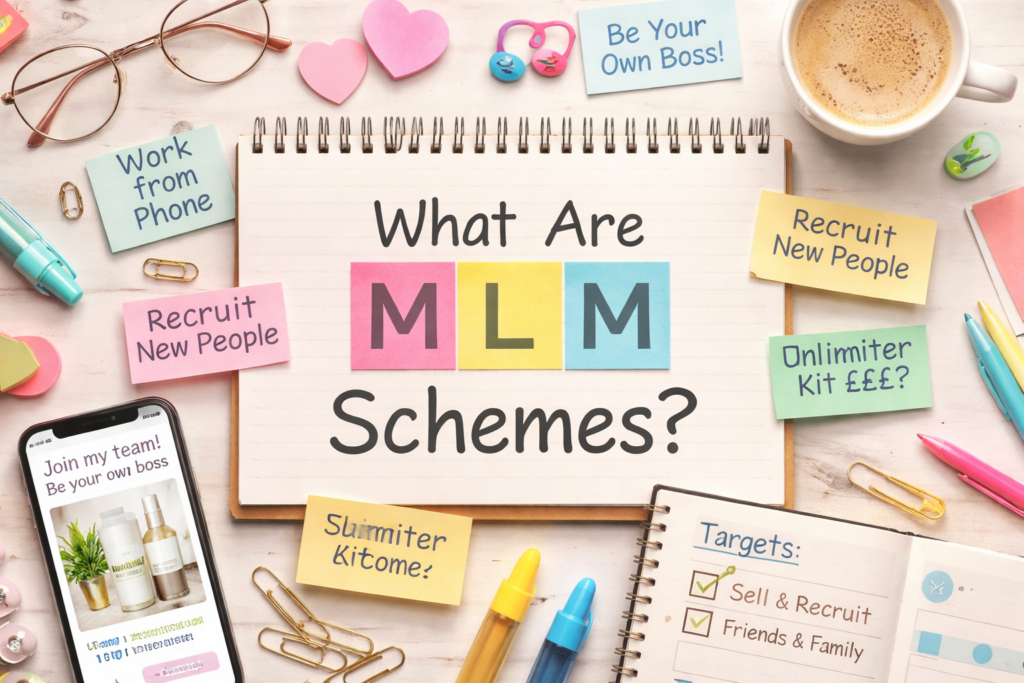
At its most basic, an MLM is a business model where people make money by selling products — but also, very often, by recruiting other people to sell those products too.
That’s the “multi-level” part.
You join under someone else. They’re your upline. If you recruit people, they become your downline. The people above you can earn a cut from what you sell, and you might earn a cut from what the people below you sell.
That’s why MLMs can feel less like a normal job and more like a chain.
According to MoneyHelper, a typical MLM often involves buying a starter kit and selling products from home, usually through social media, parties, or direct messages. They also point out that the big warning sign is when recruitment becomes a major part of how people are encouraged to earn. ()
Are MLMs illegal in the UK?
This is where people get confused.
Not all MLMs are automatically illegal in the UK. Some operate as legal direct selling businesses because they do sell actual products.
However, pyramid schemes are illegal.
The difference is important:
- A legal direct selling or MLM business sells a real product or service.
- An illegal pyramid scheme mainly makes money by recruiting new people, not from genuine retail sales.
MoneyHelper explains it quite clearly: a pyramid scheme doesn’t really rely on products at all — the main way money is made is by bringing in more people, which means most people lose money while a few at the top benefit. ()
That said, just because something is technically legal doesn’t automatically mean it’s a good idea.
Why do MLM schemes feel so convincing?
Because they’re designed to.
MLMs rarely introduce themselves as “a scheme”. They sell a lifestyle. They sell hope.
They often use phrases like:
- “Work from your phone”
- “Be your own boss”
- “Unlimited earning potential”
- “Earn around the school run”
- “Financial freedom”
- “Retire your partner”
- “Join my team”
It’s clever marketing because it targets real pain points.
If someone is struggling with childcare costs, low wages, disability, debt, loneliness, burnout, or simply wanting a bit more breathing room, that pitch can sound incredibly tempting. It’s not stupid to find it appealing. It’s human.
That’s exactly why MLMs are so effective.
How do people actually make money in an MLM?
This is the part that matters.
In theory, you make money by selling products. That might be skincare, supplements, cleaning products, cosmetics, candles, weight-loss products, or wellness items.
In reality, many people are also pushed to:
- buy a starter kit
- buy stock upfront
- stay “active” by hitting monthly minimums
- attend training or paid events
- pay for websites, tools, or subscriptions
- constantly recruit new people
So instead of simply selling products, people often end up spending money to stay in the business.
That’s why critics of MLMs say the real customers can end up being the sellers themselves.
What do the UK stats say about MLMs?
The UK’s Direct Selling Association (DSA) — which represents the industry, so it’s worth noting they are pro-direct selling — says there are around 320,000 direct sellers in the UK. They also say 73% of direct sellers generate a monthly income of up to £1,000, and 93% identify as female. Their 2024 member and seller surveys also reported £908 million in annual retail sales from member companies. ()
Now, those figures are often used by the industry to show scale and legitimacy.
But it’s worth reading them carefully.
“Up to £1,000 a month” is a very broad category. It includes people earning tiny amounts. It also doesn’t automatically tell you:
- how many hours they worked
- how much they spent
- whether that figure is profit or turnover
- how many earned little or nothing
- how many dropped out
That’s why MLM income claims can be slippery. A big number sounds impressive until you realise it doesn’t tell the full story.
Why do so many people lose money?
Because MLMs are often sold as low-risk and flexible, but the pressure builds quickly.
You’re told to invest in yourself.
You’re told to keep going.
You’re told to post more, message more people, “show up” more, believe more.
And if it doesn’t work? Too often, the blame gets pushed onto you instead of the business model.
That’s one of the biggest red flags for me.
A proper job pays you for your work.
A decent freelance business pays you for your skills.
An MLM can leave people paying to participate in the hope that success is just one more post, one more team call, or one more recruit away.
What are the warning signs of an MLM?
If you’re not sure whether something is an MLM, look out for these:
- You have to buy a starter kit to join
- There’s a lot of talk about joining a team
- Recruitment seems just as important as selling
- The products are overpriced or oddly hyped
- People keep talking about “mindset” instead of actual numbers
- There’s pressure to message friends and family
- You’re encouraged to turn your social media into a shop window
- Anyone questioning it is called “negative”
- Earnings claims are vague, emotional, or exaggerated
If it sounds more like a motivational cult than a job, trust your gut.
Where can you get proper UK advice about MLMs?
If you’re unsure, start with trusted UK sources rather than the person trying to recruit you.
MoneyHelper has a straightforward guide on whether an MLM is a good way to make money and explains the difference between MLMs and illegal pyramid schemes. They’re backed by the Money and Pensions Service, so they’re a solid place to start. ()
Citizens Advice also has scam guidance and can point you towards the consumer helpline if something feels off. They can also pass issues to Trading Standards. ()
Final thoughts on MLM schemes
So, what are MLM schemes?
They’re a business model that blends selling with recruitment — often wrapped up in the language of empowerment, flexibility, and financial freedom.
Some are legal.
Some cross serious lines.
And many, even when legal, rely on a version of “success” that simply doesn’t work for most people.
That’s the key thing.
MLMs aren’t just about products. They’re about aspiration. They sell the idea that if you just work hard enough, post often enough, and believe strongly enough, you can build a dream life.
But for a lot of people, the reality is stress, awkward conversations, blurred friendships, financial loss, and a whole lot of guilt.
If you want extra income, there are usually better, safer, more honest ways to earn it.
And if you’ve ever felt pressured by an MLM pitch, you’re allowed to say no.
Firmly.
Without apology.
Useful UK links about MLMs and direct selling
- MoneyHelper: Is a multi-level marketing scheme (MLM) a good way to make money?
https://www.moneyhelper.org.uk/en/blog/scams-and-fraud/is-a-multi-level-marketing-scheme-mlm-a-good-way-to-make-money - MoneyHelper: What is a Ponzi scheme and is it a scam?
https://www.moneyhelper.org.uk/en/blog/scams-and-fraud/what-is-a-ponzi-scheme-and-is-it-a-scam - Direct Selling Association UK (industry body) – UK direct selling stats
https://dsa.org.uk/ - Direct Selling Association UK – What is direct selling?
https://dsa.org.uk/what-is-direct-selling/ - Citizens Advice – Advice on scams
https://www.citizensadvice.org.uk/about-us/information/advice-on-scams/ - Citizens Advice – Report to Trading Standards
https://www.citizensadvice.org.uk/consumer/get-more-help/report-to-trading-standards/



 This ADHD Mum was born when I hung up my parenting blogger hat and decided to share life as I see it through the lens of someone with late diagnosed ADHD. You will find ADHD & mental health content, life as I ride the menopause rollercoaster, food, because food is life, and because we love them, all things cat.
You can reach out to me at info@thisadhdmum.com or find us on social media
This ADHD Mum was born when I hung up my parenting blogger hat and decided to share life as I see it through the lens of someone with late diagnosed ADHD. You will find ADHD & mental health content, life as I ride the menopause rollercoaster, food, because food is life, and because we love them, all things cat.
You can reach out to me at info@thisadhdmum.com or find us on social media